Preserved Craspedia is a long-lasting floral element known for its perfectly round yellow flower heads and sculptural appeal.
Native to Australia, craspedia is widely used in modern floral design, interior décor, and event styling thanks to its bold form, vibrant colour, and exceptional durability.
This flower filler has become quite popular among florists, interior designers, and stylists who want to add a striking yet minimal botanical element.
Instantly recognisable by its spherical flower heads and clean lines, this distinctive bloom brings structure, colour, and rhythm to floral compositions without overwhelming a space.
Often referred to as billy balls or drumstick flowers, Craspedia stands apart from more traditional blooms.
Its architectural form, combined with long-lasting qualities once preserved, makes it particularly well suited for contemporary interiors, professional spaces, and decorative installations where longevity and visual impact matter.
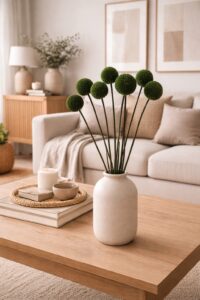 Botanical Origin and Natural Habitat
Craspedia belongs to the Asteraceae family, the same botanical family as daisies and sunflowers.
The most well-known species used in floral design is Craspedia globosa, although several related species exist.
This plant is native to Australia and New Zealand, where it grows naturally in open grasslands, rolling hills, and semi-arid regions.
In its natural environment, Craspedia thrives in full sun and well-drained soils, developing long, slender stems topped with perfectly rounded golden flower heads.
These unique blooms evolved to attract pollinators while withstanding harsh climates, which helps explain their naturally robust structure and long visual lifespan.
These qualities translate beautifully once the flower is preserved.
What makes Craspedia visually unique?
Unlike most flowering plants, this bloom does not rely on petals for visual interest.
Instead, its appeal lies in form and texture.
Each spherical flower head is composed of dozens of tiny florets packed tightly together, creating a solid, almost graphic shape.
This makes craspedia :
-
Highly architectural
-
Visually balanced and symmetrical
-
Easy to integrate into both minimalist and bold designs
Its naturally bright yellow colour is associated with warmth, optimism, and creativity, making it a powerful accent even when used sparingly.
Because of its clean silhouette, preserved Craspedia works equally well as a focal point or as a rhythmic element repeated throughout an arrangement.
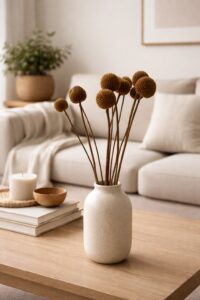
Symbolism and meaning of Craspedia
Craspedia is often associated with endurance, positivity, and good energy.
Its globe-like form symbolises unity and completeness, while its vibrant hue conveys joy and warmth.
In design contexts, these symbolic qualities make it especially popular for :
-
Welcoming spaces such as hotel lobbies and reception areas
-
Work environments that aim to feel uplifting yet professional
-
Celebratory events where colour is used intentionally rather than excessively
Preserved craspedia allows these symbolic associations to remain present over time, without the fleeting nature of fresh flowers.
Why Craspedia works so well when preserved
Once preserved, Craspedia retains its defining characteristics : shape, colour, and structure.
Unlike delicate blooms that rely on soft petals, this flower’s strength lies in its compact form, making it exceptionally stable in preserved arrangements.
Key qualities that designers appreciate include :
-
Consistent spherical shape over time
-
Minimal shedding or deformation
-
Strong visual impact even in small quantities
These attributes make it ideal for installations where reliability and uniformity are essential.
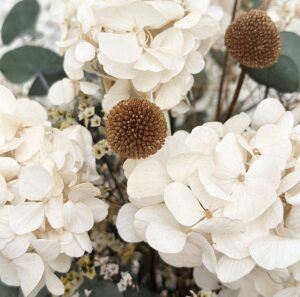 Uses of Preserved Craspedia in floral design
1. Minimalist arrangements
Preserved Craspedia is frequently used in minimalist floral compositions, where each stem is allowed to stand on its own.
A small cluster placed in a neutral vase can become a sculptural object rather than a traditional bouquet.
This approach works particularly well in :
-
Modern homes
-
Offices with clean architectural lines
-
Contemporary retail spaces
2. Accent element in mixed compositions
When combined with preserved foliage or other textured botanicals, Craspedia adds contrast and rhythm.
Its round shape offsets linear leaves, trailing elements, or feathery textures, creating visual balance within an arrangement.
It pairs especially well with muted greens, natural wood tones, and earthy materials.
3. Event and installation design
Because of its durability and consistent appearance, preserved Craspedia is often used in floral installations, including :
-
Wall features
-
Hanging installations
-
Table styling for long-lasting events
Its ability to maintain structure over time makes it a reliable choice for professional settings.
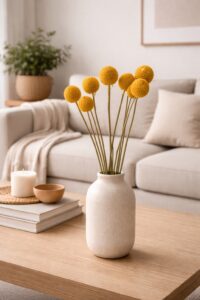 Preserved Craspedia in interior décor
Beyond floristry, preserved Craspedia has found a strong place in interior décor.
Designers increasingly treat it as a decorative object rather than a flower.
It is commonly used in :
-
Decorative bowls or sculptural vases
-
Shelf styling and coffee table arrangements
-
Reception counters
Because it does not require water or maintenance, it fits seamlessly into spaces where live plants may not be practical.
Colour psychology and visual impact
The natural yellow tone of Craspedia plays a significant role in its popularity.
Yellow is known to stimulate creativity, optimism, and mental clarity, which is sought in workspaces and communal environments.
When preserved, this colour remains stable and does not fade quickly, allowing designers to use it intentionally as a long-term accent colour rather than a seasonal one.
Used sparingly, it brings warmth without overpowering a space.
Our Craspedia is available in terracotta, green, red, black, purple, turquoise, orange, yellow or other colours upon request.
Contemporary design trends
As interior and floral design continue to move toward sustainability, longevity, and intentionality, preserved botanicals like Craspedia align perfectly with current trends.
Designers are increasingly favouring :
-
Long-lasting decorative elements
-
Reduced waste solutions
-
Natural materials with strong visual identity
Its bold simplicity fits this shift, offering a timeless aesthetic that works across styles, from Scandinavian minimalism to eclectic modern interiors.
Its strong botanical identity, architectural form, and lasting presence make it a valuable element in modern floral design and interior styling.
Rooted in the landscapes of Australia and New Zealand, this distinctive bloom brings a sense of structure, optimism, and contemporary elegance wherever it is used.
It can be used alone or integrated into complex arrangements. In either case, preserved Craspedia continues to prove that simplicity, when done well, can be incredibly powerful.